The Blueprint for Agentic HR
Most “AI agents” in HR are chatbots that push buttons. This guide shows HR technology leaders what it takes to build agents that can reason about the workforce, and how to tell the difference when a vendor pitches you.
- 36
- pages
- 7
- chapters
- Free
It comes down to what the agent knows and where it lives.
Every HR vendor now claims agents. Hooking an LLM up to your HRIS and wrapping it in a chat window makes a smarter chatbot, not an agent. The difference shows up in the architecture.
What the agent knows
Without a connected understanding of people, skills, roles and careers, an agent can retrieve data and run commands. It can’t reason about your workforce, and reasoning is where the value is.
Where the agent lives
HR tech has always struggled with adoption because it lives in portals people rarely open. The agents that change work live in Teams, Slack and Copilot, the tools people already have open all day.
Inside the blueprint
- 01
The three tiers of HR agents
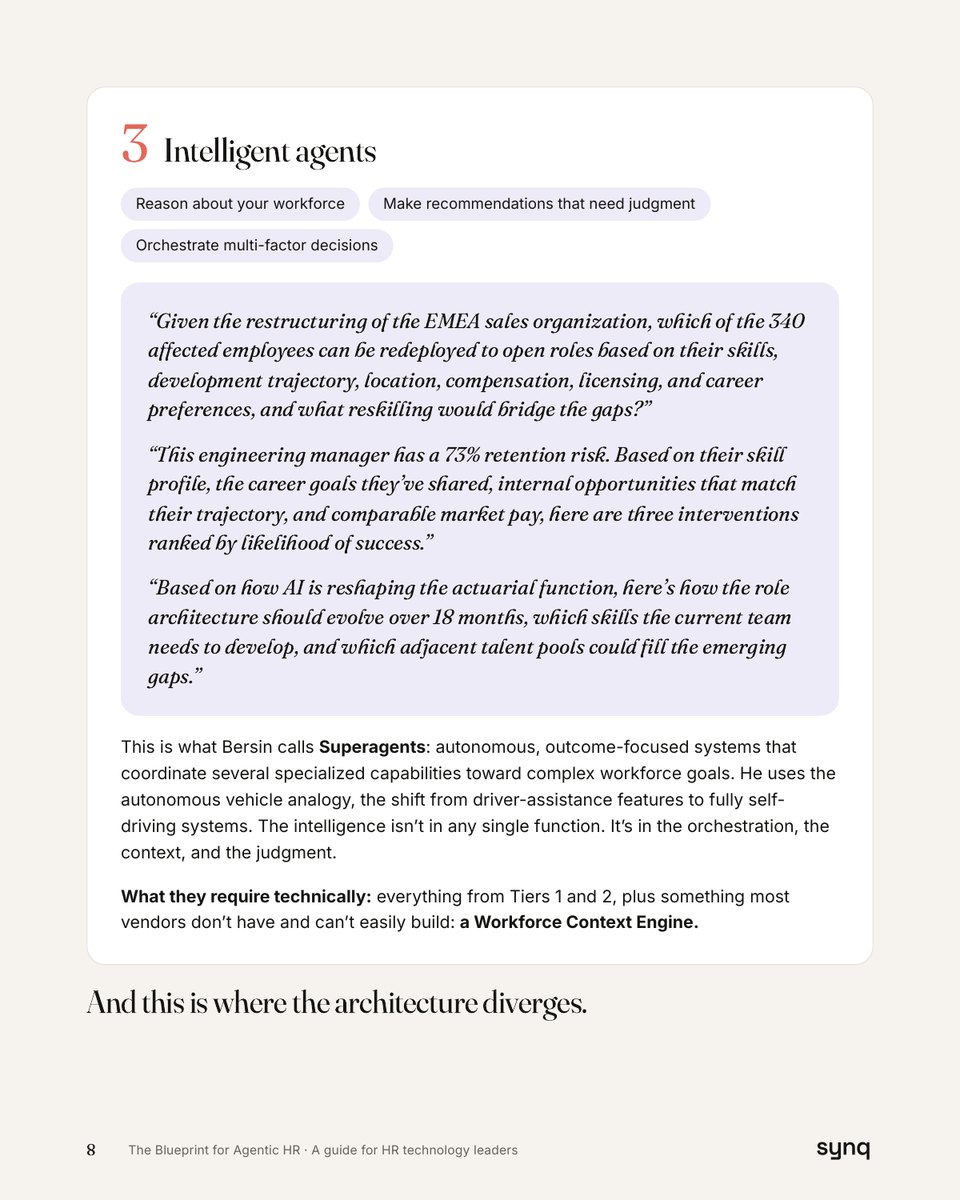
Informational, transactional, intelligent. Why only the third changes workforce decisions, and how to spot 2024 technology sold at 2026 prices.
- 02
The Workforce Context Engine
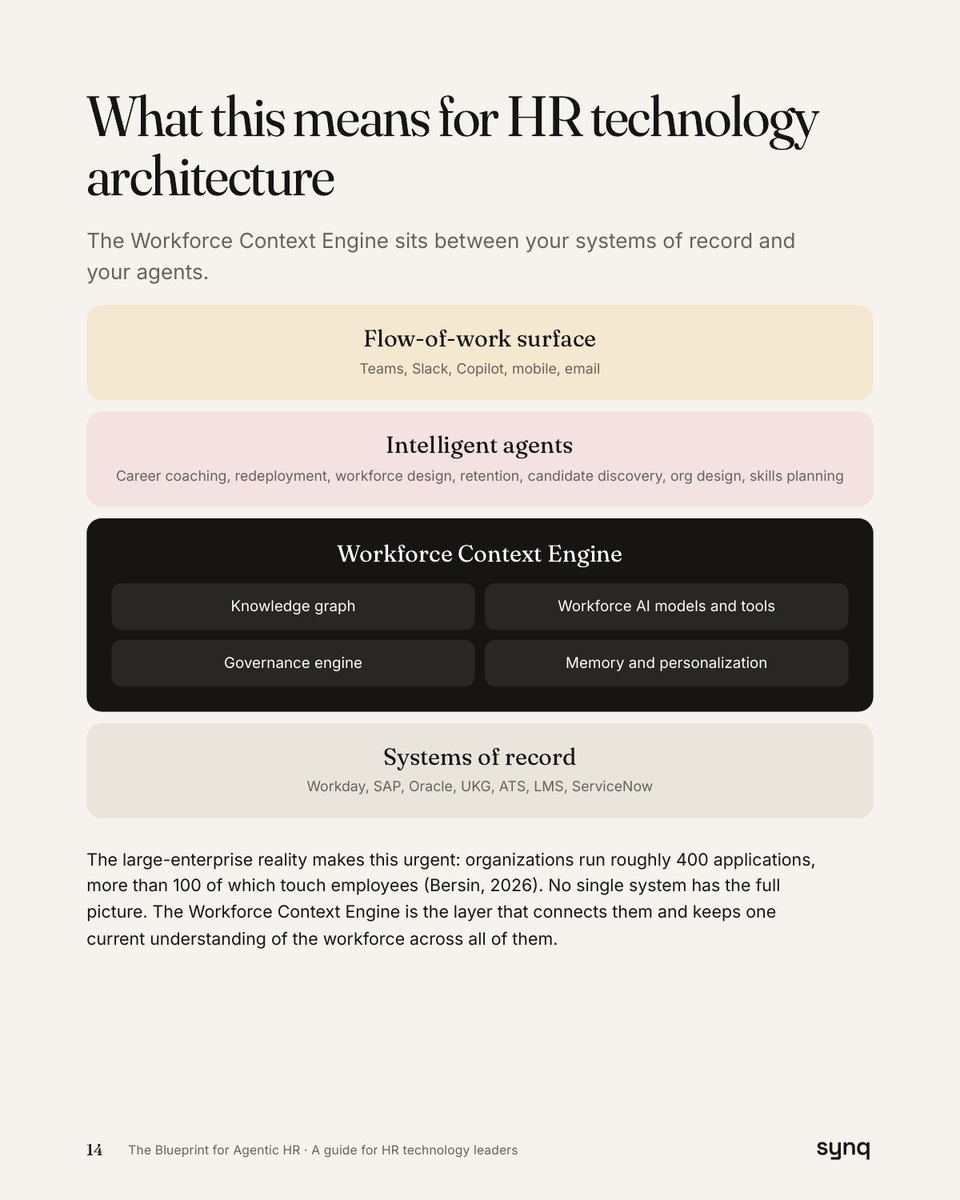
The missing layer: a knowledge graph, workforce-specific models, matching tools, a governance engine and memory, and why an LLM alone can’t replace them.
- 03
The surface problem
HR tech adoption has always failed in portals. What working in the flow of work actually takes in Teams, Slack and Copilot.
- 04
The real architecture of agentic HR
From systems of record to the flow-of-work surface, layer by layer, with a worked example of how they interact.
- 05
Governance, risk, and the EU AI Act
Why HR is high-risk, what regulators expect, why prompt-based guardrails fall short, and where to put a human in the loop.
- 06
Evaluating vendors
The questions that separate architectural substance from marketing, on context, surface, governance and multi-vendor agents.
- 07
Building your roadmap
A phased plan from foundation to transformation, with what to deploy first and what to measure.
Questions about agentic HR
Agentic HR uses AI agents that don’t just answer questions but take action and make recommendations across HR work. The guide splits them into three tiers: informational agents that answer and retrieve, transactional agents that execute steps, and intelligent agents that reason about the workforce to recommend decisions.
It’s the layer between your systems of record and your agents: a connected, continuously updated model of people, skills, roles and relationships, with workforce-specific models, matching tools, a governance engine and persistent memory. Without it, agents can retrieve and transact but can’t reason about workforce decisions.
HR technology has a long history of low adoption because it lives in portals employees rarely open. Agents in those same portals inherit the problem. Agents that work natively in the tools people already use all day get used, and can act proactively.
Yes. The EU AI Act explicitly classifies AI used in employment as high-risk, which brings obligations for risk management, data quality, logging, documentation, human oversight, robustness and transparency. The guide covers what that means for how agents are built and governed.
HR technology and HR IT leaders evaluating AI agents for their organization, and the HR and IT executives who sponsor those decisions.